The Cash-Flow Calendar: A Simple Way to Stop Bills From Sneaking Up on You
A practical monthly money system that helps you see paydays, bills, flexible spending, and small buffers before the month gets messy.
Most money stress does not come from one huge surprise. It usually comes from timing.
A bill clears two days before payday. Groceries hit during the same week as insurance. A subscription renews quietly. You technically had enough money this month, but not on the exact days you needed it.
That is where a cash-flow calendar helps.
A cash-flow calendar is not a strict budget, a complicated spreadsheet, or a guilt system. It is a simple month-at-a-glance view of when money comes in, when money goes out, and when you need to slow down. Instead of only asking, "Can I afford this?", it helps you ask, "Can I afford this right now?"
That one question can prevent overdrafts, late fees, last-minute borrowing, and the uncomfortable feeling of being surprised by your own bills.
What a cash-flow calendar does
A normal budget tells you categories: rent, food, transport, savings, entertainment.
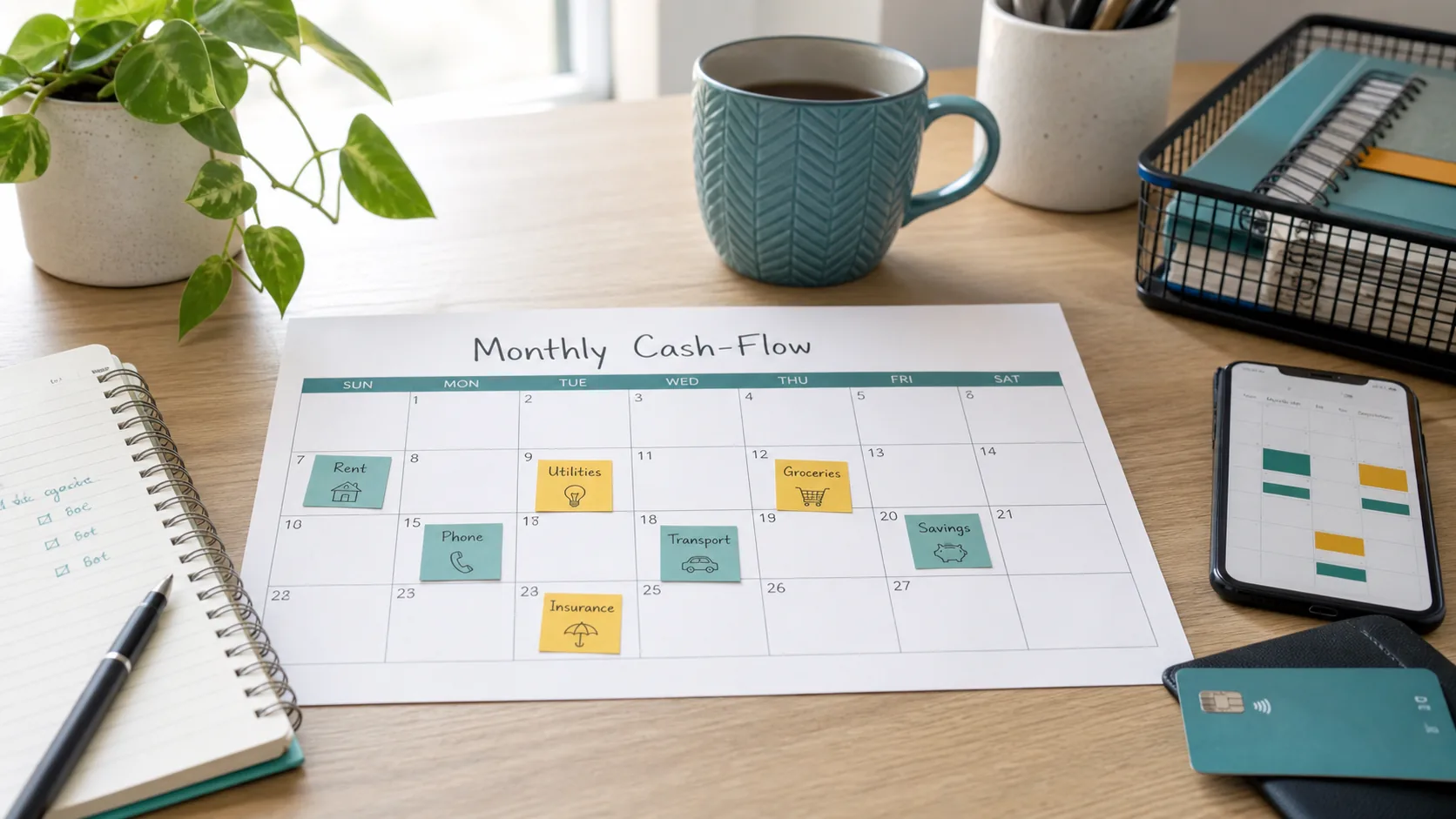
A cash-flow calendar tells you timing: payday on the 5th, rent on the 7th, phone bill on the 12th, groceries every weekend, insurance on the 24th.
Both are useful, but timing is what makes the month feel easy or tight.
If your bills are clustered at the beginning of the month, you may feel broke even with a decent income. If most expenses hit between paychecks, you may overspend early and struggle later. A calendar makes those pressure points visible before they become problems.
Start with four simple pieces
You do not need special software. A paper calendar, notes app, spreadsheet, or phone calendar can work. The best version is the one you will actually check.
Add these four things first:
| Calendar item | What to write down | Why it matters |
|---|---|---|
| Paydays | The dates money usually arrives | Shows when your month resets |
| Fixed bills | Rent, utilities, phone, insurance, loan payments | Reveals the non-negotiable dates |
| Flexible spending | Groceries, fuel, household items, eating out | Helps you pace weekly choices |
| Buffer days | Small planned pauses before big bills | Gives your account breathing room |
Do not worry about making it perfect. The first goal is visibility, not precision.
Step 1: Mark every payday
Open your calendar and mark every expected payday for the next month. If your income changes from week to week, use a conservative estimate. It is better to plan from a lower number and be pleasantly surprised than to plan from a best-case number and scramble later.
If you get paid irregularly, mark the dates when money usually lands, then add a note that says "estimate." This reminds you not to treat uncertain income like guaranteed income.
Step 2: Add fixed bills by due date
Next, add every fixed bill to the date it is due or automatically charged.
This may include:
- Rent or mortgage
- Utilities
- Phone and internet
- Insurance
- Debt payments
- Subscriptions
- Childcare
- School fees
- Minimum savings transfers
If a bill changes every month, write an average or slightly higher estimate. For example, if electricity usually falls between $75 and $95, plan for $95. That small cushion protects you from underestimating.
Step 3: Spot the heavy weeks
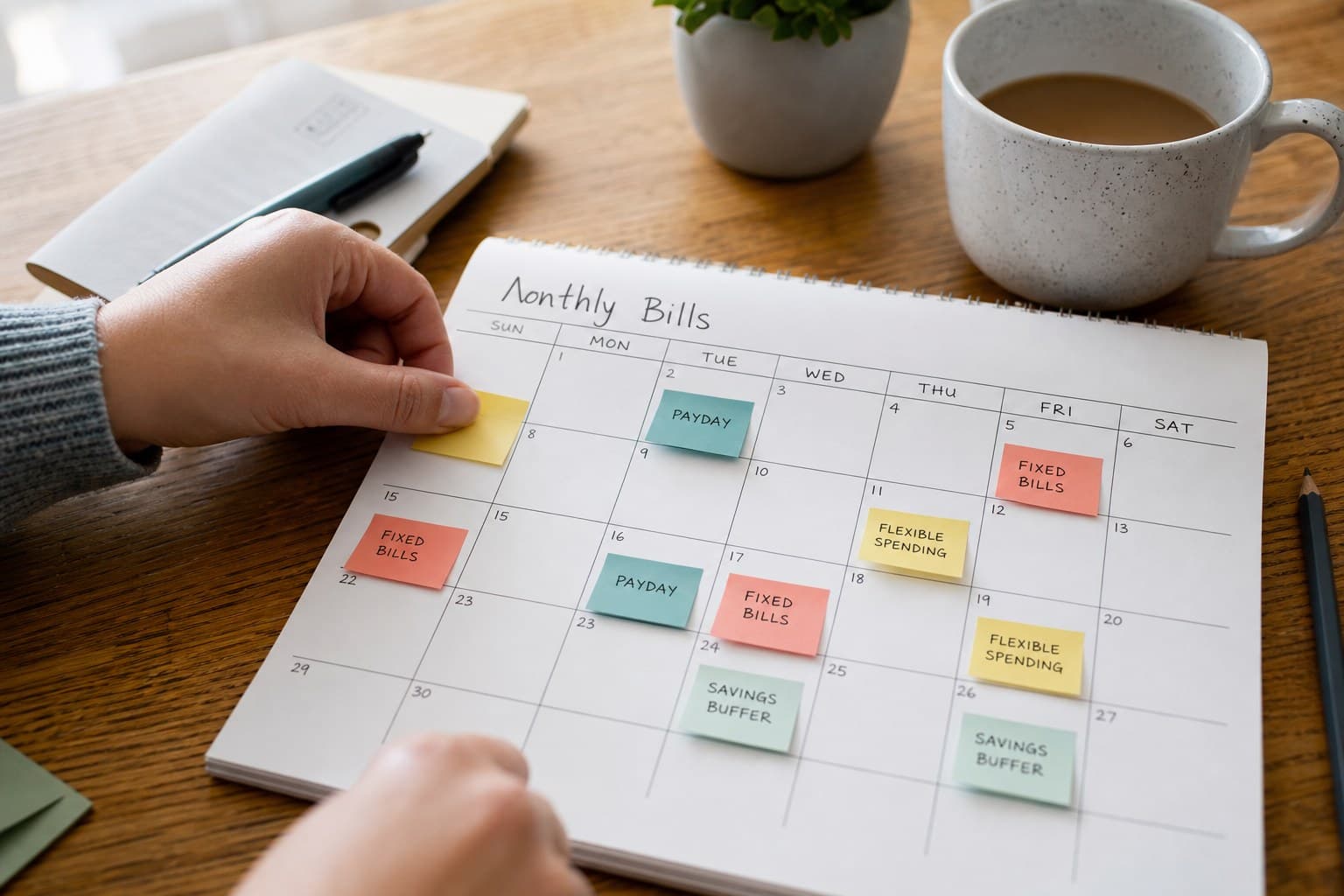
Now look at the calendar as a whole. Do not calculate yet. Just scan.
Which week has the most bills? Which paycheck is already mostly claimed? Which weekend comes right before rent, insurance, or another large payment?
These are your heavy weeks.
A heavy week does not mean you failed. It simply means that week needs different behavior. You may choose cheaper meals, delay a non-urgent purchase, or move a grocery trip earlier. The calendar turns vague stress into a clear decision.
Step 4: Create a small buffer before big bills
A buffer is money you leave alone on purpose.
It does not have to be large. Even a small amount can stop the month from tipping into fees or panic. The point is to avoid spending down to the last dollar right before a major bill clears.
Try this simple rule:
If a bill is due within three days, pause optional spending until it clears.
That does not mean you buy nothing. It means you avoid the purchases that can wait: extra takeout, random online orders, upgrades, or convenience spending. Once the bill clears, you can see what is actually left.
Step 5: Use the Now, Next, Later method
When money feels tight, categories can become confusing. The Now, Next, Later method keeps decisions simple.

Use three buckets:
| Bucket | Meaning | Examples |
|---|---|---|
| Now | Must be paid before the next payday | Rent, fuel for work, groceries, medicine |
| Next | Important, but not due immediately | Utility bill next week, school cost, insurance |
| Later | Can wait without real damage | Decor, gadgets, extra clothes, upgrades |
Before spending on something optional, ask where it belongs. If it is truly Later, it should not compete with Now money.
This is especially helpful when your account balance looks bigger than it really is. You may have $600 today, but if $480 is already needed for rent and utilities, your real flexible money is much smaller.
Step 6: Move what can be moved
Some bill dates are fixed. Others can be changed.
After you build your calendar, look for bills that are stacked too closely together. If your phone, internet, insurance, and loan payment all hit within the same few days, contact one or two providers and ask whether the due date can be moved.
You are not asking for a discount. You are asking for better timing.
Moving a bill from the 6th to the 16th can make a month feel completely different, especially if you are paid twice a month. The total amount stays the same, but the pressure spreads out.
Step 7: Plan weekly spending, not monthly wishes
Many budgets fail because they look reasonable for the month but ignore real weekly life.
For example, $500 for groceries may sound fine. But if you spend $220 in the first week, the rest of the month becomes harder. A cash-flow calendar helps you divide flexible spending by week.
Try this:
- Add up the money left after fixed bills and planned savings.
- Set aside a small buffer.
- Divide the rest by the number of weeks until next payday or month-end.
That weekly number becomes your spending pace. It is not a punishment. It is a speed limit.
Step 8: Check the calendar twice a week
A cash-flow calendar only works if you look at it.
Pick two check-in days. For many people, Sunday and Thursday work well. Sunday helps you plan the week. Thursday helps you adjust before the weekend.
During each check-in, ask:
- What bills clear before the next payday?
- What flexible spending is still needed?
- Is anything delayed, higher than expected, or missing?
- Do I need a no-spend pause for two or three days?
- Can I move a purchase to next week without a real problem?
This takes less than ten minutes once the calendar is built.
A simple example
Imagine you get paid on the 1st and 15th.
Your rent is due on the 3rd. Internet is due on the 8th. Car insurance is due on the 16th. A phone bill hits on the 21st. Groceries and fuel happen every week.
Without a calendar, the account balance after payday may feel available. With a calendar, you can see that the first paycheck is mostly for rent and internet, while the second paycheck carries insurance, phone, and the rest of the month.
That changes your choices. You might buy groceries on the 2nd but delay a clothing order until after the 8th. You might keep the weekend after the 15th lighter because insurance is about to clear. Nothing dramatic changes, but the month becomes less chaotic.
Common mistakes to avoid
Do not make the calendar too complicated. If you add too many colors, categories, and rules, you may stop using it.
Do not ignore small automatic charges. Several small renewals can hit like one large bill when they land in the same week.
Do not count money twice. If $100 is marked for a bill next week, it is not also available for eating out this week.
Do not plan from your highest possible income if your pay changes. Use a cautious number and treat extra money as a bonus.
Do not give up after one messy month. The first month teaches you where the leaks and timing problems are. The second month is usually easier.
The goal is fewer surprises
A cash-flow calendar will not magically increase income or erase every money problem. What it can do is make your month more visible.
That visibility matters. When you can see the next bill before it hits, you make calmer choices. When you know which week is heavy, you can slow down early. When you protect a small buffer, you reduce the chance of fees and last-minute stress.
You do not need a perfect financial system to feel more in control. You need a clear view of what is coming next.
Start with next month. Mark your paydays, add your bills, circle the heavy weeks, and protect a small buffer before the biggest payments. That simple calendar may become one of the most useful money tools you use all year.
Found this useful?
Send it to someone who should read it.